

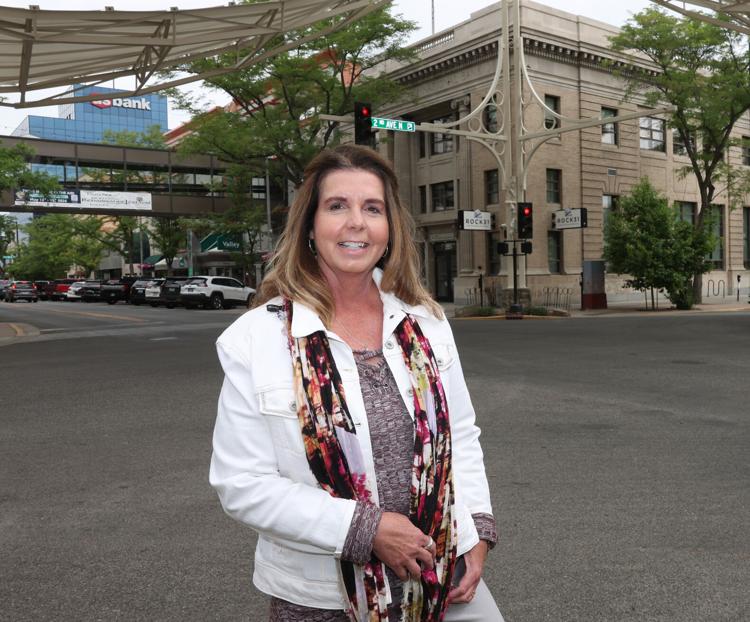
Kimberly Bailey arrived quietly.
That was by design.
If she wants to have a loud impact in her new role as executive director of Big Sky Economic Development, Bailey believes she has an important job to do first: listen — actively.
Currently about halfway through a 30-day “listening tour,” Bailey has been meeting with staff, stakeholders and board members to hear what the Billings business community needs to thrive.
“I am really huge about listening,” Bailey said. “I need to understand where their heads are, what they would like to see from the organization going forward, and then I can advise them accordingly after that.”
Bailey joins BSED at a time of recent upheaval.
When longtime director Steve Arveschoug retired last year after two decades on the job, the organization underwent a cut in county funding, dropping from $1.5 million in fiscal year 2025, to $1.3M in 2026. That resulted in the reduction of six staff positions, including the entire workforce program. To top it off, newly hired director Paul Green resigned after less than a year in the post.
“We lost some really great staff,” BSED board chairwoman Lucy Aspinwall said. “Our community needs workforce. That is probably one of the hardest ones that we lost, because we lost the entire program. We need to find a way to get that back.”
Few county-funded entities have emerged completely unscathed from Yellowstone County’s budget cuts in the last two fiscal years.
According to the county’s 2027 preliminary budget documents, mills from Big Sky Economic Development as well as local museums were reallocated to the city’s general fund to support public safety. And more cuts could be coming to BSED.
The county is in the midst of trying to convince voters to approve a $175 million bond and $20 million annual operational levy to finance and staff an expansion of the often-overcrowded Yellowstone County Detention Facility.
If the bond does not pass, Yellowstone County Commission Chair Mark Morse told the Gazette that more cuts could be coming.
“There will probably be additional cuts at mid-year budget next year,” Morse said. “And the cuts we would have to make then would probably exceed what we did this go-around. Now, I’m not saying that that we would target BSED. I’m speaking in general terms, that we would have to cut the budget further if the jail expansion doesn’t pass.”
Morse said the passing of the bond would relieve pressure and open the door to revisiting funding for entities like BSED, although not immediately.
“I don’t want everybody to expect that they’re going to get an immediate return to funding that they used to have,” Morse said. “But we would certainly have another discussion about that when we weren’t supporting, you know, $6 million a year out of the budget to the public safety.”
While he won’t rule out further cuts, Morse said BSED plays an important role as a steward of the local economy.
“They are the county economic development arm,” Morse said, “and they are important to the ongoing prosperity of Yellowstone County.”
Morse isn’t the only one who believes BSED plays a critical role in the local economy. And Downtown Billings Partnership Economic Development Director Mehmet Casey, for one, doesn’t want to see further cuts limit BSED’s role.
“Given that the county, region and state at times rely heavily on their programs and several of our constituents utilize them whether they’re business or property owners, it’s highly critical that their service doesn’t get disrupted, be reduced or be eliminated,” Casey said. “Downtown and Billings tend to be very entrepreneurial, so any kind of sudden change will create confusion, dissatisfaction and a general feeling of receiving little to no support.”
“Over the years,” Casey continued, “BSED has built a robust legacy. And it looks like BSED has recently stabilized the ship by filling all of their vacancies, including a new executive director. So it’ll be equally significant to build off of this momentum, leverage their offerings to maintain and recruit more business activity, and continue to be one of the leaders in shaping the vision of this city’s economic development scene.”
Numerous past and present projects that have helped shape the Billings economic landscape have been credited to BSED’s efforts.
“BSED has been involved in numerous transformative projects by helping organize partnerships, conduct economic analysis, facilitate funding discussions, and advocate for investment,” Aspinwall said.
Recent examples of BSED-supported projects include Rocky Vista University’s College of Veterinary Medicine, the Amazon Fulfillment Center, Signal Peak Ice Arena, downtown redevelopment projects, military and aviation facility investments as well as healthcare and higher education expansions.
While the aforementioned projects have high visibility in Billings and tangible economic impact to the region, they do not include the hundreds of businesses BSED has helped through business advising, financing assistance, Small Business Development Center services, procurement assistance and revolving loan programs, Aspinwall said.
Also important, Aspinwall said, was BSED’s role in the creation and growth of Rock31 and related entrepreneurial programs, “which have helped foster a culture of innovation and startup development in Eastern Montana.”
The organization has become the primary “front door” for entrepreneurs and expanding businesses seeking technical assistance, business planning, capital access and growth strategies, Aspinwall said.
BSED is also often the first point of contact for national companies inquiring about the Yellowstone County market.
As prominent Billings developer Steve Corning sees it, though, BSED is often operating at a disadvantage because of the lack of public sector tools available for development in Montana, outside of Tax Increment Financing.
In many states, Corning said, governments actively use sales tax revenue, property tax abatements and other tax breaks or inducements to help make projects feasible.
“We’ve had interest over the years from big, big players, and the first question they always say is, ‘Well, what’s the grab bag of goodies that the state and the city can offer us?’ And the answer is virtually nothing,” he said.
And because of the challenging economic environment they operate within, Corning said it’s essential for BSED to have great leadership at the helm.
“I think individuals make a huge difference. It’s the people that take a leadership role that stick their necks out, so to speak,” Corning said. “BSED kind of needs someone to stick their neck out for them in a way.”
And that’s exactly what Bailey intends to do.
Despite recent upheaval at BSED, Bailey is optimistic. She thinks the organization can find funding streams outside of county funding, and she believes BSED has maintained an even keel despite recent turnover at the organization’s top.
“It hasn’t had a long term of disturbance. It’s only been a concentrated (over) eight to nine months. So, if you look at the legacy of Steve’s time … it had a very good stability track record, right? You’re really just looking at a blip of time,” Bailey said. “We look forward to going through its evolution into its next concurrence, and really, the staff that is here is very dedicated, very passionate in what they do, and they’re very optimistic. I find that enriching, the past two weeks that I’ve been doing one-on-one dialogs with them.”
Bailey is confident in BSED’s deal-making capabilities as a whole, and in its ability to bridge gaps in the community through other funding streams, such as federal grants, membership contributions, Rock 31 rental and real estate revenue, revolving loan funds and local and state financing tools like tax increment financing.
Steve Arveschoug, then executive director of Big Sky Economic Development smiles as confetti rains down following the ribbon cutting during the grand opening ribbon cutting ceremony for Rock31 in September 2022.
“We’re kind of like the negotiator, the mediator showing the vitality potential of a project, and then understanding what the needs are from the local side of the house,” Bailey said. “And then hopefully bridging those gaps together is where we kind of plug and play.”
What initially attracted Bailey to BSED, she said, “was the diversity of their portfolio of services. I mean, they run everything in the gamut that I’ve not seen in any other (economic development organization) in the nation. … For this size of a community, the breadth that they cover here is quite, quite impressive.”
As director, Bailey hopes to add to the organization’s already strong “track record” of success and continue to grow support for its mission in the community.
Over Bailey’s 14-year career in economic and community development, she’s led projects focused on business investment, redevelopment, infrastructure planning and long-term economic growth.
Bailey comes to Billings by way of Fountain, Colorado, where she was the city’s director of economic development and urban renewal. Before moving out West, she worked in business development for the city of St. Petersburg, Florida.
Throughout her career, Bailey has worked with local governments, businesses, developers and community leaders to advance projects that strengthen local economies and create opportunities. She’s also worked extensively with tax increment financing, “handling the deals to make private development flourish in communities.”
Bailey has also done work with the Department of Defense.
“I’m not a military brat, but for whatever reason I find myself in those communities,” she said. “I can help them hopefully work in a partnership effort with that agency, and how we can transfer that into good economy on the private sector side.”
She maintained good working relationships with both the Air Force and Coast Guard while in Florida and worked very closely with the five military installations in southern Colorado, before making the move to Billings.
BSED Marketing Director Sam Loveridge said the board is eager to capitalize on Bailey’s connection with the DOD.
Bailey said fostering good community and regional partnerships is integral to the workings of a private-public organization like BSED.
She calls it the connective tissue.
“It’s all about relationship building,” Bailey said. “Collaboration is huge, because everybody rowing in the same fashion usually supports the larger need of attainment. We are a public-private partnership, and so bringing those dialogs together and working with those stakeholders is how you make those things happen fully.”
Bailey’s emphasis on collaboration, both outside of and within the organization, is what has BSED co-chair Jen Cobza so excited.
“She’s looking at ways that our staff can lean on each other instead of operating in silos. … How do we use our partners and our teams to work together to maybe help a business or a community project move forward?” Cobza said. “We’re going to be fiscally responsible with Kimberly at the helm and make smart choices.”